Showing posts with label st. patrick. Show all posts

Sunday, 6 February 2011

St. Patrick and the Faeries - Part 2

It might be fair to say that, in my last blog, the connection between St. Patrick and the Fae was 'circumstantial'. Based on the evidence of his own 'Confession' it seems that Banwen has a strong case for claiming to be his birthplace, but the fact there are also stories of faeries in the area may be nothing more than coincidence. However, i would like to present to you another story that i have discovered, one in which this particular Saint's faerie connection can't be denied. This story is set just a short distance towards the coast from Banwen and the Sarn Helen Roman road, at a place called Crymlyn (meaning curved lake).
'Crumlyn Lake, near the quaint village of Briton Ferry, is one of the many in Wales which are a resort of the elfin dames. It is also believed that a large town lies swallowed up there, and that the Gwragedd Annwn have turned the submerged walls to use as the superstructure of their fairy palaces. Some claim to have seen the towers of beautiful castles lifting their battlements beneath the surface of the dark waters, and fairy bells are at times heard ringing from these towers. The way the elfin dames first came to dwell there was this:
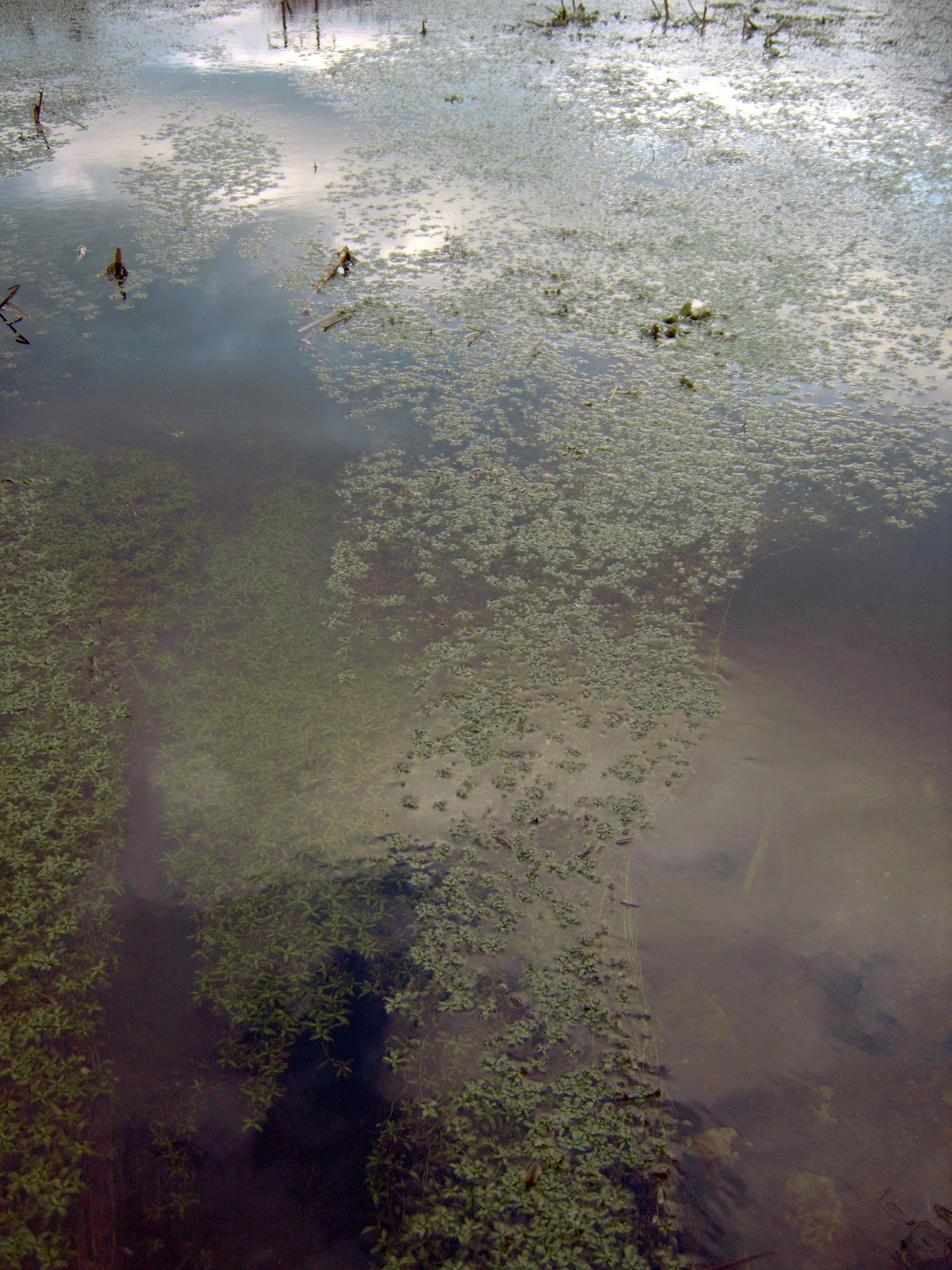
A long, ay, a very long time ago, St. Patrick came over from Ireland on a visit to St. David of Wales, just to say 'Sut yr y'ch chwi?' (How d'ye do?); and as they were strolling by this lake conversing on religious topics in a friendly manner, some Welsh people who had ascertained that it was St. Patrick, and being angry at him for leaving Cambria for Erin, began to abuse him in the Welsh language, his native tongue. Of course such an insult could not go unpunished, and St. Patrick caused his villifiers to be transformed into fishes; but some of them being females, were converted into fairies instead. It is also related that the sun, on account of this insolence to so holy a man, never shed its life-giving rays upon the dark waters of this picturesque lake, except during one week of the year.' (From British Goblins by Wirt Sykes).

Despite many attempts to drain the lake the area remains boggy and is now a nature reserve. The swallowed town is said to be the original town of Swansea. 

Just to finish, i thought you might be interested in seeing this. It is from the 11th Century, much later than the standing stone i talked about in Part 1, and part of a Celtic Cross. It is carved in in the Irish style and thought to show a priest at prayer. It was found on  mountain near Banwen. Could it be it's an image of St. Patrick? Maybe they knew something then which has long since been forgotten.

Monday, 20 September 2010

St. Patrick and the Faeries - Part 1

In Neath, in South Wales, is a beautiful Country Park called 'The Gnoll'. It was created during the 1800's by the then owner of the estate, a Lady Mackworth. Being of considerable influence she had requested the collection of various interesting standing stones from around the area, which were used as decorative features in the grounds.

One of these stones was obtained from an area near to a Roman road at Banwen - an area which was known as a favourite spot of the local faeries. One account tells of diminutive faeries having been seen in their hundreds at this spot, riding along the road four a-breast on tiny white horses; and it was here that local people had been known to join in with the faeries song and dance. The stone itself was inscribed with a mysterious language, a faery language it was assumed as the fae had been seen dancing around the stone on fine evenings. This stone was added to the grotto that Lady Mackworth created, along with others that she had acquired, just one hundred yards south of the house. But soon after there was a terrible thunder storm and the grotto was destroyed. It was generally agreed that this was an act of revenge by the faeries. The following is an account from the gentleman who was under-gardener at the gnoll at that time;
"..fairies were constantly seen on a fine evening by Clwyda'r Banwan, dancing within the rings; but since the wonderful stone (on which was written fairy language in their characters, for nobody had ever understood them) had been removed from the centre of the largest circle to Gnoll gardens, nobody had ever seen the fairies. But they had their revenge; for no sooner had the grotto, which cost Lady Mackworth thousands of pounds, been finished, than one evening -- oh! I shall never forget it! -- there was thunder and lightning and rain, such as was never seen or heard before; and next morning the grotto had disappeared, for the hill behind it fell over it, and has hidden it for ever; and woe betide the man that will dare to clear away the earth. When the storm abated we all heard the fairies laughing heartily". (CISP)

The grotto was left ruined and in the early 1900s the stone was taken to Swansea Museum where it can be seen today. The inscription is thought to be Latin, which probably did seem like a faerie language at the time. The Gnoll Country Park is beautifully maintained, but the housing estate next to it has many problems, such as addiction, crime, unemployment etc. I tend to think of this as a continuing example of the faeries revenge as that estate is ironically named 'Fairyland'.

I visited the stone in the museum but I wanted to try and find the place where it used to stand; not in the Gnoll but in it's original position near the Roman road at Banwen.

It's very easy to find this road as Banwen is hardly more than the 60 or so houses that run along it. Though a minor road now, I think we can assume that this road would have been of considerable importance in it's day. This is part of the Sarn Helen Roman Road, and Banwen  is situated between the two Roman towns of Neath (Nidum) and Brecon (Cicucium). Infact, aerial photos reveal just how significant Banwen was to the Romans as the remains of a Roman Fort, Marching Camp and a building (possibly a Villa) are still visible. The local residents assert that this is the birthplace of St. Patrick and having looked into this I tend to agree.

We know from his own letters, that Patrick was born to a noble Romano-British family (probably in the 5th century) and that he was kidnapped and taken to Ireland in his teens. In his 'Confession' he writes;  "I, Patrick, a sinner, a most simple countryman, the least of all the faithful and most contemptible to many, had for father the deacon Calpurnius, son of the late Potitus, a presbyter, of the settlement of Bannaven Taburniae; he had a small villa nearby where I was taken captive." He was treated as a slave for six years after which he briefly returned to Britain and his family.

View tafarn y banwen in a larger map

Could Bannaven Taburniae be Banwen? Many places do claim to be his birthplace of course, and the Latin place name is broken up accordingly in order to justify such claims. However, it seems that Banwen shares more than a passing resemblance to the Latin when you consider it's older name of Tafarn-y-Banwen. It is my belief that Bannaven Taberniae is simply the Latin version of this Welsh place name, which means the White Peak Tavern. As for the faeries, they are often found in  saintly locations in Wales, and it may be that they provide evidence of pre-Christian worship at such sites. In my next blog I want to share a story which explicitly links Patrick with the faeries, and perhaps provides even further evidence of his connection with this particular area of Wales.